Why your 1RM grows most with heavy sets
Sets of 8 to 12 build muscle about as well as heavy sets, but strength grows most at 80% of max or more. See the research and how to add heavy sets.
By Squatly
Published 7 min read
Years of steady training can put real muscle on you and still leave your bench close to where it was. If that sounds like you, look at how heavy your sets are. Sets of 8 to 12 reps build muscle about as well as heavier sets, but they tend to do less for your 1RM.
How heavy a set of 8 to 12 is
Your reps and reps in reserve tell you roughly what percentage of your max a set was. Nuzzo and colleagues' 2024 meta-analysis turned hundreds of reps-to-failure tests into tables of average reps at each percentage of max, with a separate table for bench press.1 On bench, the average lifter got about 4 reps at 90% of max, 9 at 80%, 12 at 75% and 14 at 70%.
You can also read that table the other way round. A set of 10 stopped with 2 or 3 reps left is a weight you could lift 12 or 13 times, which on bench is about 72 to 74% of max. The chart below does the same for each rep target.
| Set, stopped with 2 reps left | Share of max |
|---|---|
| 12 reps | 70% |
| 10 reps | 74% |
| 8 reps | 78% |
| 5 reps | 84% |
| 3 reps | 88% |
On bench, a set of 8 to 12 reps with 2 or 3 left is a weight the average lifter could lift 10 to 15 times, which is about 68 to 78% of max. If every set in your week looks like that, none of your sets are above 80% of max.
Those numbers are for the average lifter. At 80% of max, about two in three lifters get 7 to 11 reps, so for you the same set could be a few percent of max higher or lower. The estimated 1RM page shows how much that spread moves an estimate.
Take a lifter with a 275 lb bench whose week is 3 × 10 at 200 lb and 3 × 8 at 210 lb, each set stopped short of failure. On the bench table, the average lifter could do about 13 reps at 200 and 11 at 210, so every set ends about 3 reps short. That's six hard sets, and none of them is above 76% of max.
| Set | Weight | % of max | Reps left |
|---|---|---|---|
| 3 × 10 | 200 lb | 73% | about 3 |
| 3 × 8 | 210 lb | 76% | about 3 |
Heavier sets raise your 1RM more
Your 1RM depends on how much muscle you have and how well you use it for one heavy rep. Sets of 8 to 12 build the muscle, but they don't give you much practice with weights near your max, and a max test asks for exactly that. In the studies that compared loads, heavier loads raised 1RM more while muscle growth was about the same.
Lopez and colleagues' network meta-analysis included 28 studies of 747 adults, with every set taken to failure; 21 of the studies were in untrained people, and none in highly strength-trained lifters.2 For strength, sets of 8 reps or fewer clearly beat sets of more than 15. Sets of 9 to 15 also beat sets of more than 15, by about two thirds as much. When sets of 8 or fewer were compared with sets of 9 to 15, the result leaned toward the heavier sets, but the difference wasn't statistically significant. Muscle growth didn't differ by load in any comparison.
| Load comparison | Strength | Muscle size |
|---|---|---|
| Heavy vs light | 0.51 | 0.12 |
| Moderate vs light | 0.34 | 0.20 |
| Heavy vs moderate | 0.16 | −0.09 |
Currier and colleagues' 2023 network meta-analysis ranked combinations of load, sets and weekly sessions. Its strength comparisons drew on 178 studies and 5,097 people, and its muscle comparisons on 119 studies and 3,364 people. Many of the combinations scored close to one another. For strength, the top-ranked ones used loads of 80% of max or more with multiple sets. The single highest-ranked one used three or more sessions a week, and twice a week was almost as good. For muscle, every combination came out comparable, and multiple sets ranked highest.3
Schoenfeld and colleagues' 2017 meta-analysis of 21 studies, with every set taken to failure, compared loads above 60% of max with loads of 60% or less. The heavier loads raised 1RM more but not isometric strength, and muscle growth was similar.4 Its light group used 60% of max or less, so the study compares heavy loads with light ones. It doesn't tell you how sets of 8 to 12 compare with sets of 3 to 5.
Lees and colleagues' 2025 study tested load within the same person. In it, 20 young men trained one arm and one leg with 8 to 12 reps at about 70 to 80% of max and the other arm and leg with 20 to 25 reps at about 30 to 40%. They did three sets of one-arm curls and one-leg knee extensions, each to volitional fatigue, three days a week for 10 weeks. The heavy and the light limbs grew about the same.5
More sets mostly add muscle
In Schoenfeld's 2019 study, 34 trained men did 1, 3 or 5 sets per exercise, three days a week for eight weeks, with every set taken to failure at 8 to 12 reps.6 Squat and bench 1RM gains didn't differ between the groups. Quad and biceps thickness grew more with 5 sets than with 1.
| Sets per exercise, 3 days a week | Squat 1RM | Outer quad thickness |
|---|---|---|
| 1 set | 18.1% | 5.0% |
| 3 sets | 11.8% | 7.9% |
| 5 sets | 18.4% | 13.7% |
A 2026 meta-regression by Pelland and colleagues, drawing on 67 studies, found that both size and strength rose with weekly sets, and that the diminishing returns were "considerably more pronounced" for strength.7
Sets closer to failure mostly add muscle too
In Robinson and colleagues' meta-regressions, which worked from estimated reps left, muscle growth rose as sets ended closer to failure, while strength gains stayed similar across a wide range of reps left.8 Going all the way to failure gave at most a small extra edge in growth over stopping short.9 The article on how close to failure you should train goes through those studies in more detail.
How much does muscle count toward a max?
It depends on how long you've trained. Summing up earlier research, Greg Nuckols writes that growth explained very little of the differences in strength gain between untrained lifters, about 20 to 30% in lifters with a few months of training, and often 40 to 70% in small studies of highly trained lifters.10 In his reading, technique gains slow down as lifters train longer, so muscle growth explains more and more of who gets stronger.
If you've trained for several years, the muscle you've built does count toward your max. A week of only sets of 8 to 12 keeps building it, but in the studies above, 1RM went up most with heavier loads.
Adding heavy sets to your week
The simplest change is to keep your volume work and make two of the week's bench sets heavy. For the lifter with the 275 lb bench, that means swapping two of the sets of 8 for two sets of 3 at 240 lb. That's 87% of max, a weight the average bencher could lift about 5 times, so each set of 3 stops about 2 reps short of failure. The week still has six hard sets, and two of them are now above 80%.
| Set | Weight | % of max | Reps left |
|---|---|---|---|
| 3 × 10 | 200 lb | 73% | about 3 |
| 1 × 8 | 210 lb | 76% | about 3 |
| 2 × 3 | 240 lb | 87% | about 2 |
At 240, about two in three lifters could do 4 to 7 reps, so your own number may be different from the average. Set the weight by RPE instead. Start at a weight where the first set of 3 feels like RPE 8, and add 5 lb when both sets feel like RPE 7. Do the same on squat. Run it for 8 to 10 weeks, then retest your max.
Training both in Squatly
If you'd rather follow a program that already sets up your week this way, DUP Strength & Size 4-Day builds heavy sets and volume work into every week. Squat and bench each get a heavy day of 5 reps or fewer and a volume day of 8 to 12. In the program's workouts, bench on the heavy day works up to top sets of 5, 4 and 3 at RPE 7.5, 8.5 and 9, which on the bench table is about 83 to 90% of max for the average lifter. On the volume day, bench is done in sets of 12 and 10 at RPE 8 and 9. The deadlift is trained heavy once a week, with Romanian deadlifts on the volume day. It runs for 10 weeks and comes with Squatly Pro.
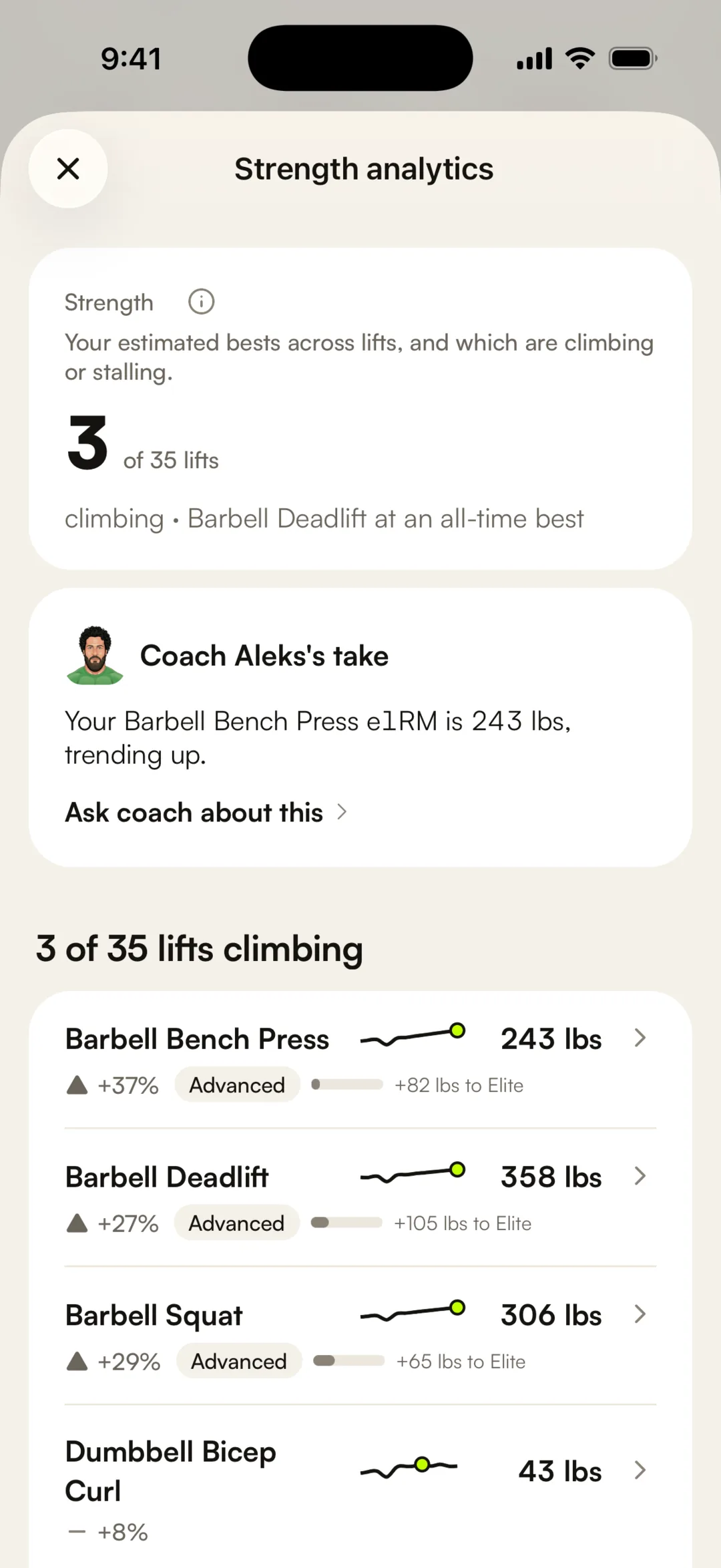
Once you've run it for a few weeks, the Strength screen in Progress shows which of your lifts are going up, with a trend for each one, your bench included.
 DUP Strength & Size 4-DayPowerlifting · 10 weeks · 4 days a weekView program
References
- 1
Maximal number of repetitions at percentages of the one repetition maximum: a meta-regression and moderator analysis of sex, age, training status, and exercise
Nuzzo JL, Pinto MD, Nosaka K, Steele J, 2024, Sports Medicine
doi.org/10.1007/s40279-023-01937-7pmc.ncbi.nlm.nih.govBack to text
- 2
Resistance training load effects on muscle hypertrophy and strength gain: systematic review and network meta-analysis
Lopez P, Radaelli R, Taaffe DR, Newton RU, Galvão DA, Trajano GS, et al., 2021, Medicine and Science in Sports and Exercise
doi.org/10.1249/MSS.0000000000002585pmc.ncbi.nlm.nih.govBack to text
- 3
Resistance training prescription for muscle strength and hypertrophy in healthy adults: a systematic review and Bayesian network meta-analysis
Currier BS, Mcleod JC, Banfield L, Beyene J, Welton NJ, D'Souza AC, et al., 2023, British Journal of Sports Medicine
doi.org/10.1136/bjsports-2023-106807pmc.ncbi.nlm.nih.govBack to text
- 4
Strength and hypertrophy adaptations between low- vs. high-load resistance training: a systematic review and meta-analysis
Schoenfeld BJ, Grgic J, Ogborn D, Krieger JW, 2017, Journal of Strength and Conditioning Research
- 5
Resistance training load does not determine resistance training-induced hypertrophy across upper and lower limbs in healthy young males
Lees MJ, Mcleod JC, Morton RW, Currier BS, Fliss MD, McKellar SR, et al., 2025, The Journal of Physiology
- 6
Resistance training volume enhances muscle hypertrophy but not strength in trained men
Schoenfeld BJ, Contreras B, Krieger J, Grgic J, Delcastillo K, Belliard R, Alto A, 2019, Medicine and Science in Sports and Exercise
doi.org/10.1249/MSS.0000000000001764pmc.ncbi.nlm.nih.govBack to text
- 7
The resistance training dose response: meta-regressions exploring the effects of weekly volume and frequency on muscle hypertrophy and strength gains
Pelland JC, Remmert JF, Robinson ZP, Hinson SR, Zourdos MC, 2026, Sports Medicine
- 8
Exploring the dose-response relationship between estimated resistance training proximity to failure, strength gain, and muscle hypertrophy: a series of meta-regressions
Robinson ZP, Pelland JC, Remmert JF, Refalo MC, Jukic I, Steele J, Zourdos MC, 2024, Sports Medicine
- 9
Influence of resistance training proximity-to-failure on skeletal muscle hypertrophy: a systematic review with meta-analysis
Refalo MC, Helms ER, Trexler ET, Hamilton DL, Fyfe JJ, 2023, Sports Medicine
doi.org/10.1007/s40279-022-01784-ypmc.ncbi.nlm.nih.govBack to text
- 10
Is the correlation between hypertrophy and strength gains stronger than we realized?
Nuckols G, 2026, Stronger By Science