How accurate are lifters at calling RPE?
Trained lifters called reps in reserve within about a rep on bench near failure and missed by 2 to 5 reps on a long squat set. You can check your own calls.
By Squatly
Published 8 min read
- RPE
- Research
Every time you log an RPE, you're calling how many more reps you could have done. How close to failure should you train? covers why that number matters for muscle and strength. Below are the studies on how close lifters' calls are on different kinds of sets, and how much weight a bad call costs you.
Trained lifters calling 1 and 3 reps left on bench near failure missed by 0.65 reps on average. The same calls on one squat set of about 16 reps missed by 2.05 and 3.65 reps, and a call of 5 left missed by 5.15. Across studies, people on average had about a rep more left than they thought.
How the studies measure it
Most of the studies here ask lifters for their reps in reserve directly, which is what the reps-in-reserve version of the RPE scale is built on.10 In most of them, lifters say their call out loud partway through a set, keep going to failure, and the researchers count the reps that were really left. The difference between what they called and what they really had left is the miss. A few of the studies here worked differently, such as one that asked for a prediction before the set, and the pooled analysis below mixes several designs.
Studies report the miss in two ways. One keeps the direction. If you call two left and really had three, you called one rep too few, and if you really had one, you called one rep too many, so in an average those two cancel out. The other ignores direction and counts both as a one-rep miss. That version shows how far off a typical call is, and the first one shows whether lifters tend to call too few or too many.
On bench near failure, lifters called it within about a rep
Refalo and colleagues had 24 trained lifters, 12 men and 12 women, take bench press sets at 75% of their max to failure. Partway through each set, lifters made one call, either one rep left or three.1
- The average miss was 0.65 reps. Misses are whole reps, so with an average that small, most calls were off by a rep or less.
- With direction counted, lifters on average had 0.17 reps more left than they called, with a spread of 1.0 rep.
- Calls of one left and three left were about as good as each other, and so were the first and second set, and the first and second session.
- Sex, years of training and relative bench strength showed no link with how well a lifter called it.
The same calls on a long squat set
Zourdos and colleagues had 25 men with an average of 4.7 years of training squat 70% of their max for one set to failure. The sets ran to 16 reps on average. Partway through the set, the lifters called RPE 9, 7 and 5, meaning one, three and five reps left.2 The first two are the same calls as in the bench study, though here all three came in one set, while each bench set had one.
| call | Average miss |
|---|---|
| Bench, 1 and 3 left | 0.65 reps |
| Squat, 1 left | 2.05 reps |
| Squat, 3 left | 3.65 reps |
| Squat, 5 left | 5.15 reps |
The calls got better as the set went on, but even the call of one left missed by about two reps. Within the study, the longer a lifter's set ran, the worse their two early calls were, but the call of one left showed no such link. Years of training did not predict who called it well.2
So on the same calls, lifters missed by several times more on the squat set than on the bench sets. The two studies differ in the lift, the load and the lifters, and the bench study doesn't report how many reps its sets ran to, so on their own they can't show which of those caused the gap. The lift may matter. In an eight-week study of 42 trained men and women, calls on bench were more accurate than calls on squat.7 Set length may matter too. The pooled analysis below found no clear difference between upper- and lower-body exercises, but it did find that calls got worse on longer sets.
When you think you have hit failure
Lifters also have more left than they think at the very end of a set. Armes and colleagues had lifters with at least a year of training do knee extensions, on some days stopping where they thought the next rep would fail, and on others going to real failure. In one experiment the load was 70% of their 1RM, and the gap was 0.8 reps. In the other it was 70% of their maximal isometric force on the machine, and the gap was 2.8. With both experiments pooled, lifters got about two more reps on the days they went to real failure, with the estimate ranging from zero to four.3
Across the studies
Halperin and colleagues pooled 12 studies with 414 people. On average, people thought they had 0.95 reps fewer left than they really did, which is about one rep.4
About a rep is the pooled average, but the 12 studies disagreed widely with each other. Trained lifters calling bench sets near failure did better than that average, and calls made early in a long set did far worse.
The same analysis found some kinds of sets where calls were better.4
- Calls were better on sets that ran to 12 reps or fewer than on longer ones.
- Calls were slightly better in later sets of an exercise.
- Calls made nearer the end of a set were slightly better, though the range around that estimate runs to zero.
Training status didn't seem to matter, and neither did whether the exercise was for the upper or lower body.
Does experience or practice help?
Among trained lifters, years of training don't seem to matter much. The pooled analysis found no clear effect of training status, and neither the bench nor the squat study above found a link with years of training.412 In a small study of Smith machine squats at 70% of max, scored from bar speed, 8 lifters with 18 months or more of training judged their reps in reserve no better than 8 with less.6 Across a wider range, from new gym members to lifters with years of training, one study of 141 people doing single sets to failure found accuracy tended to improve with experience, though the more experienced lifters there also used heavier loads relative to their max.5
Studies of practice have mixed results, and they tested different people.
- In two studies, calls got better with practice. The 42 trained men and women in the eight-week study got more accurate on bench over the training, but on squat the change was unclear.7 In 26 adults, younger and older, who had lifted before but were new to calling reps in reserve, misses shrank over six sessions. On leg press, the call of four left went from missing by 4.6 reps to 2.3 in the younger group and 2.5 in the older one. On bench, misses fell by under a rep.9
- In another, nine trained men who benched three times a week for six weeks, calling their reps in reserve on the last set each time, didn't get measurably more accurate.8
What a miss costs in weight
Your RPE call decides your next weight, so a call that's off by a rep or two puts your next weight off as well. Say you bench 185 lb for 6 and call it RPE 8, which means two reps left, so you think you could have done 8. The Epley formula turns that into an estimated max, and the estimated max gives the weight that would really have been RPE 8 for 6.
- weight lifted
- reps done plus reps left
| Reps really left after 185 lb for 6 | Weight for 6 reps at RPE 8 |
|---|---|
| 4 | 195 lb |
| 3 | 190 lb |
| 2 | 185 lb |
| 1 | 180 lb |
| 0 | 175 lb |
On a set like this, a one-rep miss is worth about 5 lb, or 2.6% of the weight, and a two-rep miss is worth about 10 lb. On the long squat set, the early calls missed by 3.65 and 5.15 reps, so the miss in load there is bigger. Past about 10 reps the formula itself gets less accurate, which the e1RM page explains.
What this means for your own sets
If you aim to stop one to two reps short of failure, the pooled average suggests you're really stopping with two to three left. But most of the pooled studies used sets of more than 10 reps, and on bench near failure lifters had only 0.17 reps more left than they called. Calls got clearly worse on sets that ran past about 12 reps to failure, so your calls are most reliable on hard sets of 12 reps or fewer. On longer sets, treat your calls as rough estimates, especially early ones at RPE 7 or lower.
Every few weeks, take the last set of a familiar lift to failure on a machine or in a rack with the safeties set. Use a weight you get 12 reps or fewer with. Note the rep you would have called RPE 8, then count the reps that came after it. If you get three or four more instead of two, your RPE 8 was really a 6 or 7, and the weights you pick from it are too light.
Repeat it a few times before you change how you rate. Even on bench near failure, where the average miss was small, single calls varied around it, so one check can be a rep off.
How Squatly uses your ratings
With Squatly Pro, the coach suggests each lift's next session from the weight, reps and ratings you logged. A single rating can be a rep off, so a small gap between your ratings and the target doesn't change the weight. Your ratings move the weight on their own only when the sets you rated average more than a full point above or below the lift's target RPE. That's the target your plan sets, or RPE 8 if your plan doesn't set one. When the gap is smaller, the coach sets the weight from your reps. During a workout, the coach also reads each set you rate and can suggest a change to the next one.
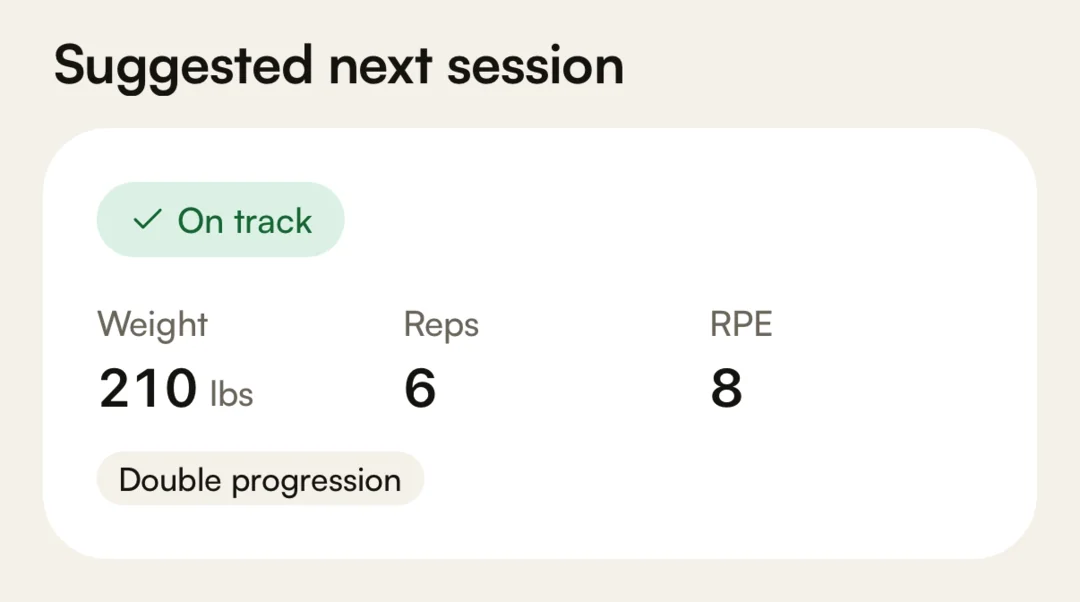
Across sessions, the coach follows your effort on each lift. If it keeps climbing, the coach stops adding weight to that lift, and if the lift has also stalled, it suggests taking 10 percent off. The effort tracking page shows how your ratings set the next weight.
References
- 1
Accuracy of intraset repetitions-in-reserve predictions during the bench press exercise in resistance-trained male and female subjects
Refalo MC, Remmert JF, Pelland JC, Robinson ZP, Zourdos MC, Hamilton DL, Fyfe JJ, Helms ER, 2024, Journal of Strength and Conditioning Research
- 2
Proximity to failure and total repetitions performed in a set influences accuracy of intraset repetitions in reserve-based rating of perceived exertion
Zourdos MC, Goldsmith JA, Helms ER, Trepeck C, Halle JL, Mendez KM, et al., 2021, Journal of Strength and Conditioning Research
- 3
"Just one more rep!": ability to predict proximity to task failure in resistance trained persons
Armes C, Standish-Hunt H, Androulakis-Korakakis P, Michalopoulos N, Georgieva T, Hammond A, et al., 2020, Frontiers in Psychology
doi.org/10.3389/fpsyg.2020.565416pmc.ncbi.nlm.nih.govBack to text
- 4
Accuracy in predicting repetitions to task failure in resistance exercise: a scoping review and exploratory meta-analysis
Halperin I, Malleron T, Har-Nir I, Androulakis-Korakakis P, Wolf M, Fisher J, Steele J, 2022, Sports Medicine
- 5
Ability to predict repetitions to momentary failure is not perfectly accurate, though improves with resistance training experience
Steele J, Endres A, Fisher J, Gentil P, Giessing J, 2017, PeerJ
- 6
Objective accuracy in estimating repetitions in reserve in the back squat: an analysis between experienced vs. novice subjects
Droguett FAB, Festa RR, Quintana NAT, Gomez-Lopez J, Ojeda ÁH, Farias-Valenzuela C, Giakoni-Ramírez F, Jofré-Saldía E, 2025, Journal of Human Kinetics
- 7
Without fail: muscular adaptations in single-set resistance training performed to failure or with repetitions-in-reserve
Hermann T, Mohan AE, Enes A, Sapuppo M, Piñero A, Zamanzadeh A, et al., 2025, Medicine and Science in Sports and Exercise
- 8
Changes in intraset repetitions in reserve prediction accuracy during six weeks of bench press training in trained men
Remmert JF, Robinson ZP, Pelland JC, John TA, Dinh S, Hinson SR, et al., 2023, Perceptual and Motor Skills
doi.org/10.1177/00315125231189098pubmed.ncbi.nlm.nih.govBack to text
- 9
Trainability of repetitions-in-reserve estimation in younger and older adults: a parallel-group repeated-measures study
Wiedenmann T, Kunellis D, Rappelt L, Held S, Wicker P, Donath L, 2026, BMC Sports Science, Medicine and Rehabilitation
doi.org/10.1186/s13102-026-01997-ypmc.ncbi.nlm.nih.govBack to text
- 10
Novel resistance training-specific rating of perceived exertion scale measuring repetitions in reserve
Zourdos MC, Klemp A, Dolan C, Quiles JM, Schau KA, Jo E, et al., 2016, Journal of Strength and Conditioning Research