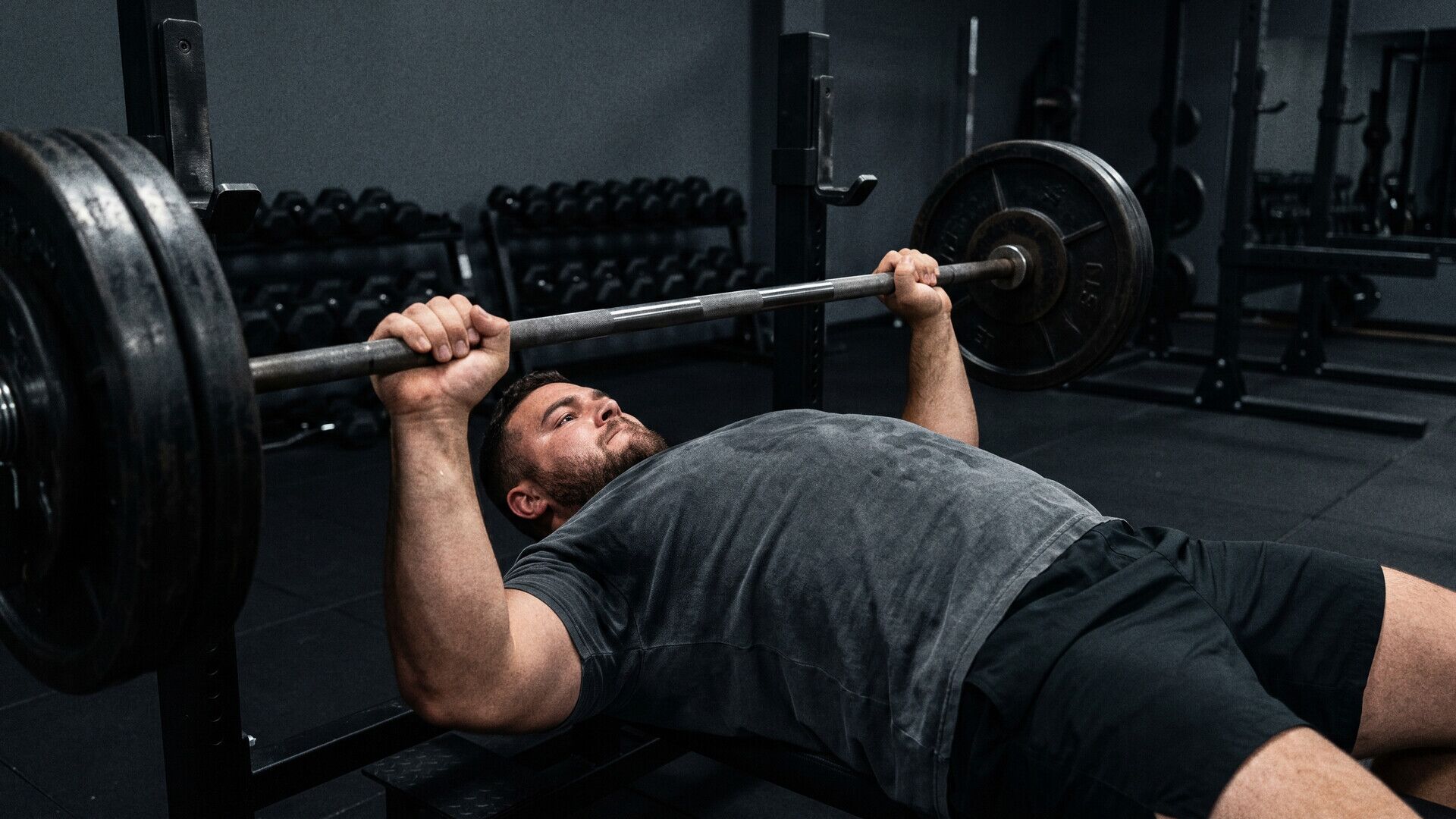
Every working set ends somewhere between an easy stop and a rep you can't finish. Where you stop changes how much muscle the set builds and how much it takes out of you, so it is worth knowing how close you actually need to get.
Reps in reserve
The most useful way to describe how hard a set was is the number of reps you had left when you racked the bar: reps in reserve, or RIR. The RPE scale most lifters use is built on the same idea. RPE 10 means nothing left, RPE 9 means one rep left, RPE 8 means two, and so on down the scale.[1]
The scale counts down from 10: each rep you had left when you racked the bar takes one point off.On a weight you could lift for ten reps at most, stopping at eight is RPE 8: two reps left.
Zourdos and colleagues introduced this version of the scale in 2016. In experienced squatters, the ratings tracked bar speed closely: the slower the rep moved, the higher the lifter rated it.[1]
What the research shows
Myth
Sets only build muscle if you take them to failure. When Refalo and colleagues pooled 15 studies, the advantage of training to failure was trivial, and the studies that compared true failure with stopping short found no clear difference.[2]
That does not mean effort stops mattering. A 2024 analysis by Robinson and colleagues looked at the whole range instead of failure against no failure. They estimated how many reps each training group in the studies had left at the end of its sets, then asked how growth and strength changed with that number.[3]
Strength
Muscle size
Estimated gains by how many reps were left at the end of each set, from ten left down to none. Muscle growth climbs as sets end closer to failure. Strength stays almost flat.
Reps left when the set ended
Strength
Muscle size
10
14.7%
3.7%
9
14.8%
4.2%
8
14.9%
4.7%
7
14.9%
5.2%
6
15.0%
5.7%
5
15.1%
6.2%
4
15.1%
6.7%
3
15.2%
7.2%
2
15.3%
7.7%
1
15.4%
8.3%
0
15.4%
8.8%
Estimated gains by how many reps were left at the end of each set, from ten left down to none. Muscle growth climbs as sets end closer to failure. Strength stays almost flat.Model estimates: Robinson et al. 2024
Muscle growth rose steadily as sets ended closer to failure. Strength gains barely moved: the model put them at about 15 percent whether sets stopped at zero reps left or ten. That fits with the pooled studies above. Growth keeps rising toward failure, but the last step is small: going from two reps left to none added about one percentage point of growth in the model. The authors also point out that the reps left were estimated from how each study described its training, so the exact numbers are uncertain.[3]
The cleanest test so far trained each leg of the same lifter differently. In Refalo's 2024 study, 18 trained men and women did leg press and leg extension twice a week for eight weeks. One leg went to failure on every set. The other stopped with two reps left on the leg press and one rep left on the leg extension.[4]
Each dot is one lifter: quad thickness gained in the leg trained to failure (across) and in the leg that stopped one to two reps short (up). Dots near the line grew about the same in both legs, and lifters who grew a lot grew in both. On average the legs gained 1.80 mm and 1.82 mm.
Leg trained to failure
Leg stopped 1 to 2 reps short
1.3 mm
1.1 mm
1.2 mm
1.1 mm
1.1 mm
1.4 mm
1.3 mm
1.4 mm
0.8 mm
0.6 mm
3.6 mm
3.4 mm
0.7 mm
0.9 mm
3.4 mm
2.7 mm
3.9 mm
4.5 mm
3.9 mm
4.8 mm
1.5 mm
0.8 mm
2.0 mm
1.3 mm
0.6 mm
1.3 mm
1.1 mm
1.7 mm
1.1 mm
1.7 mm
1.3 mm
0.6 mm
1.1 mm
1.1 mm
2.6 mm
2.3 mm
Each dot is one lifter: quad thickness gained in the leg trained to failure (across) and in the leg that stopped one to two reps short (up). Dots near the line grew about the same in both legs, and lifters who grew a lot grew in both. On average the legs gained 1.80 mm and 1.82 mm.Data: Refalo et al. 2024, open dataset (osf.io/34d92)
Both legs grew by the same amount. What differed was fatigue. The leg trained to failure lost more reps from its first set to its last on both exercises, and on the leg press its lifting speed dropped further within each session. Even so, the two legs did about the same total number of reps.[4]
To failure
1 to 2 reps short
Reps lost from the first set to the last, averaged across the eight weeks. Taking every set to failure cost more reps on the sets that followed.
exercise
To failure
1 to 2 reps short
Leg press
20.4%
15.8%
Leg extension
29.9%
21.4%
Reps lost from the first set to the last, averaged across the eight weeks. Taking every set to failure cost more reps on the sets that followed.Data: Refalo et al. 2024
Key point
For most working sets, stopping one or two reps short of failure builds about as much muscle as going all the way, and leaves more in the tank for the sets that follow. If strength is the goal, the case for failure is weaker still.
Judging how many reps you have left
Rating your reps in reserve takes practice. Across 12 studies and 414 lifters, people thought they had about one rep less in the tank than they really did. Their guesses got better as the set got closer to failure, and on sets of 12 reps or fewer.[5]
So a set you call RPE 8 may well have had three reps left, not two. The way to sharpen your read is to test it against a set taken to a real limit now and then. 5/3/1: Boring But Big builds that in: the last main set of each day is for as many reps as you can get. Two Hard Sets: Minimum-Dose Hypertrophy uses the same idea on every movement: a top set stopped one to two reps short, then a lighter back-off set taken to failure, or to one rep short on hinges and single-leg work.
The last working set of each main lift is for as many reps as you can, a regular check on your effort ratings.
What Squatly does with your ratings
Squatly's logger puts an RPE column next to weight and reps on every set. You rate the set when you finish it, from 6 to 10 in half points.
9:41
02:30
Bench Press•••
Tight setup, full ROM. Pause briefly at the chest. Bar drifts slightly forward at the top.
SetPrevLbsRepsRPE
1185 × 518557
Rest: 2:30
2185 × 518557
Rest: 2:30
3185 × 518557.5
02:30
418558
Rest: 2:30
+ Add Set
Incline Dumbbell Press•••
Bench at 30°. Drive the dumbbells slightly together at the top.
SetPrevLbsRepsRPE
165 × 97088
Rest: 2:30
265 × 117088
Rest: 2:30
365 × 107088
Rest: 2:30
Bench press at 185 lb for five, rated RPE 7, 7 and 7.5, with the rest timer running.
Every completed set that isn't marked as a warm-up also counts toward the weekly volume of the muscles it trains: a full set for the main muscles, half a set for the ones that assist. So mark warm-ups as warm-ups, and keep your working sets close enough to failure that the count means something.
Volume · This Week
In the productive zone
12of 14
1 below target · 12 productive · 1 above
Push
Chest12sets
Side Delts9sets
Pull
Lats14sets
Legs
Quads11sets
Hamstrings5sets
below target
Squatly's weekly volume card, shown with sample data: hard sets for each muscle against a productive range.
How Squatly uses this
The coach uses the RPE you log. For each lift, it compares the average RPE of your last session with the target your plan sets, or RPE 8 if the plan sets none. When the same weight comes in more than a point easier, it moves you up a step for next time. When it comes in more than a point harder, it takes a step off. See how it works.
References
1
Novel resistance training-specific rating of perceived exertion scale measuring repetitions in reserve
Zourdos MC, Klemp A, Dolan C, Quiles JM, Schau KA, Jo E, et al. · , 2016 · , Journal of Strength and Conditioning Research
Exploring the dose-response relationship between estimated resistance training proximity to failure, strength gain, and muscle hypertrophy: a series of meta-regressions
Robinson ZP, Pelland JC, Remmert JF, Refalo MC, Jukic I, Steele J, Zourdos MC · , 2024 · , Sports Medicine
Similar muscle hypertrophy following eight weeks of resistance training to momentary muscular failure or with repetitions-in-reserve in resistance-trained individuals
Refalo MC, Helms ER, Robinson ZP, Hamilton DL, Fyfe JJ · , 2024 · , Journal of Sports Sciences